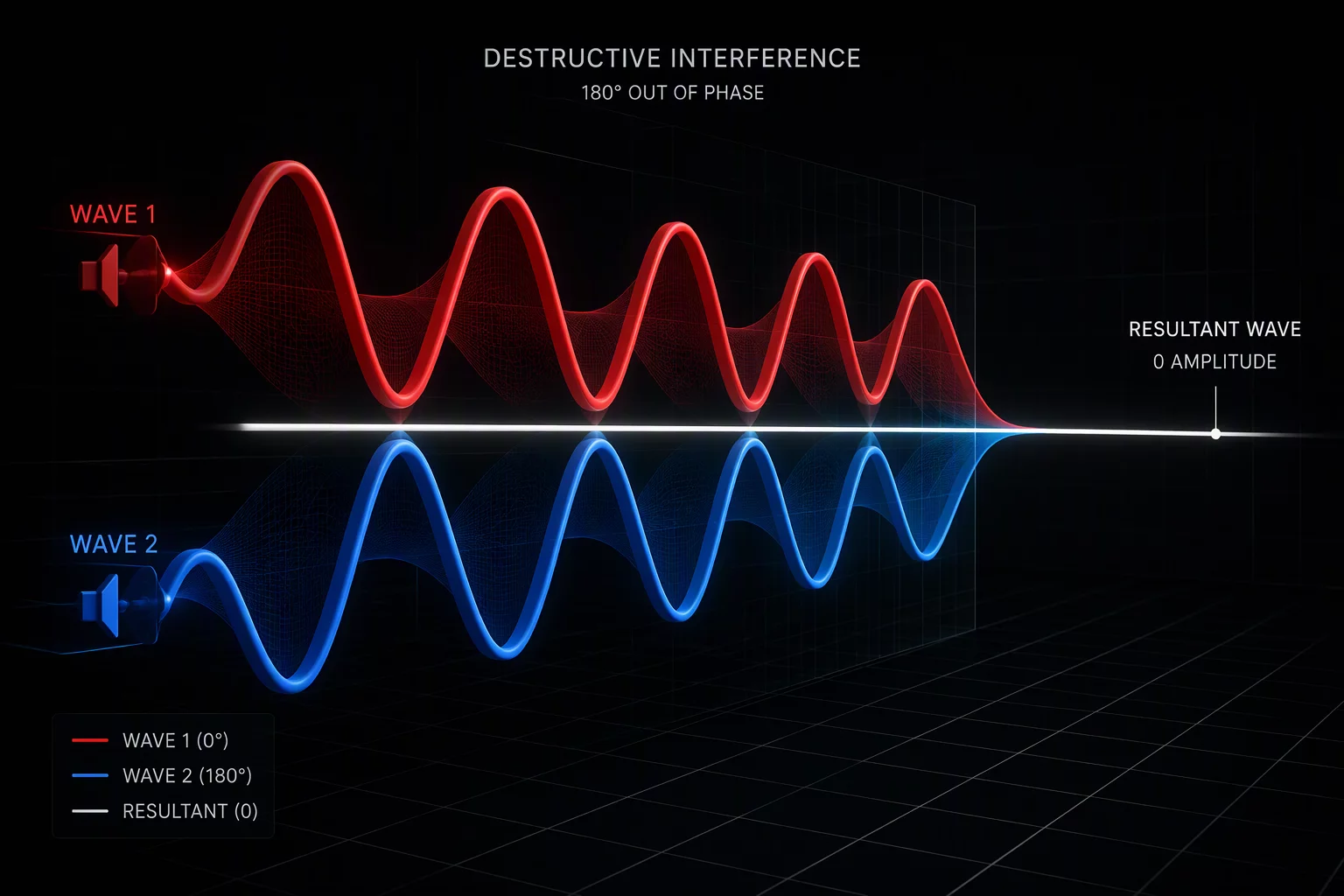
Crossfading two audio segments is rarely just a mathematical blend between a fade-out and a fade-in. When adjacent dialogue clips carry common room tone, acoustic bleed, or shared harmonic frequencies from the same speaker, overlapping their heads and tails causes physical wave summation that can instantly hollow out vital speech fundamentals.
In multi-track dialogue assemblies and vocal comps, editors frequently encounter sudden hollow artifacts right over a splice point. This comb filtering does not originate from bad EQ or improper mastering processors; it is the immediate acoustic consequence of combining two coherent or semi-coherent signals with small time offsets inside the crossfade transition. Delays as small as two milliseconds between adjacent wave cycles cause reciprocal cancellation at fundamental frequencies, leaving dialogue sounding thin and distant.
Identifying Comb Filtering and Polarity Misalignment
When audio clips containing correlated audio overlap, the crossfade duration acts as an interference zone. If two speech waveforms from identical room acoustics or alternative takes overlap by even two or three milliseconds out of phase, destructive interference cancels specific low-mid frequencies. The human voice instantly loses chest resonance, sounding thin and boxy for the duration of the fade.
Flipping clip polarity before setting crossfade lengths offers an instant diagnostic check. By inverting the phase of the incoming clip and listening in mono, an engineer can hear whether the edit point suddenly restores warmth or further attenuates the signal. If flipping polarity clears the muddiness or restores lost body, the primary issue is wave cancellation rather than frequency masking.
Critical Phase Mitigation Rules
- Restrict crossfade lengths to micro-transitions (under 8 milliseconds) on highly correlated audio to limit the temporal duration of destructive wave cancellation.
- Align zero-crossings precisely at the splice point so waveforms start their transition in positive cycle synchronicity rather than opposing polarities.
- Test crossfaded regions in summed mono listening mode to immediately expose spectral thinning that stereo monitoring may obscure.
Slope Geometry and Offset Management
Choosing the proper crossfade slope directly impacts phase coherence. Equal-gain (linear) crossfades produce a 3 dB dip at the midpoint on completely uncorrelated signals, but they provide flat summing on correlated, in-phase audio. Conversely, equal-power curves boost the center by 3 dB, which causes an audible gain surge if the overlapping clips happen to be coherent and in phase.
When phase cancellation occurs on room tone or ambient background air behind speech, moving the edit point by as little as a single zero-crossing cycle (often less than a millisecond) alters the phase relationship enough to convert destructive interference into transparent reinforcement. Always nudge the cut boundary before reaching for restorative EQ or dynamic suppression.